Aureon Engine
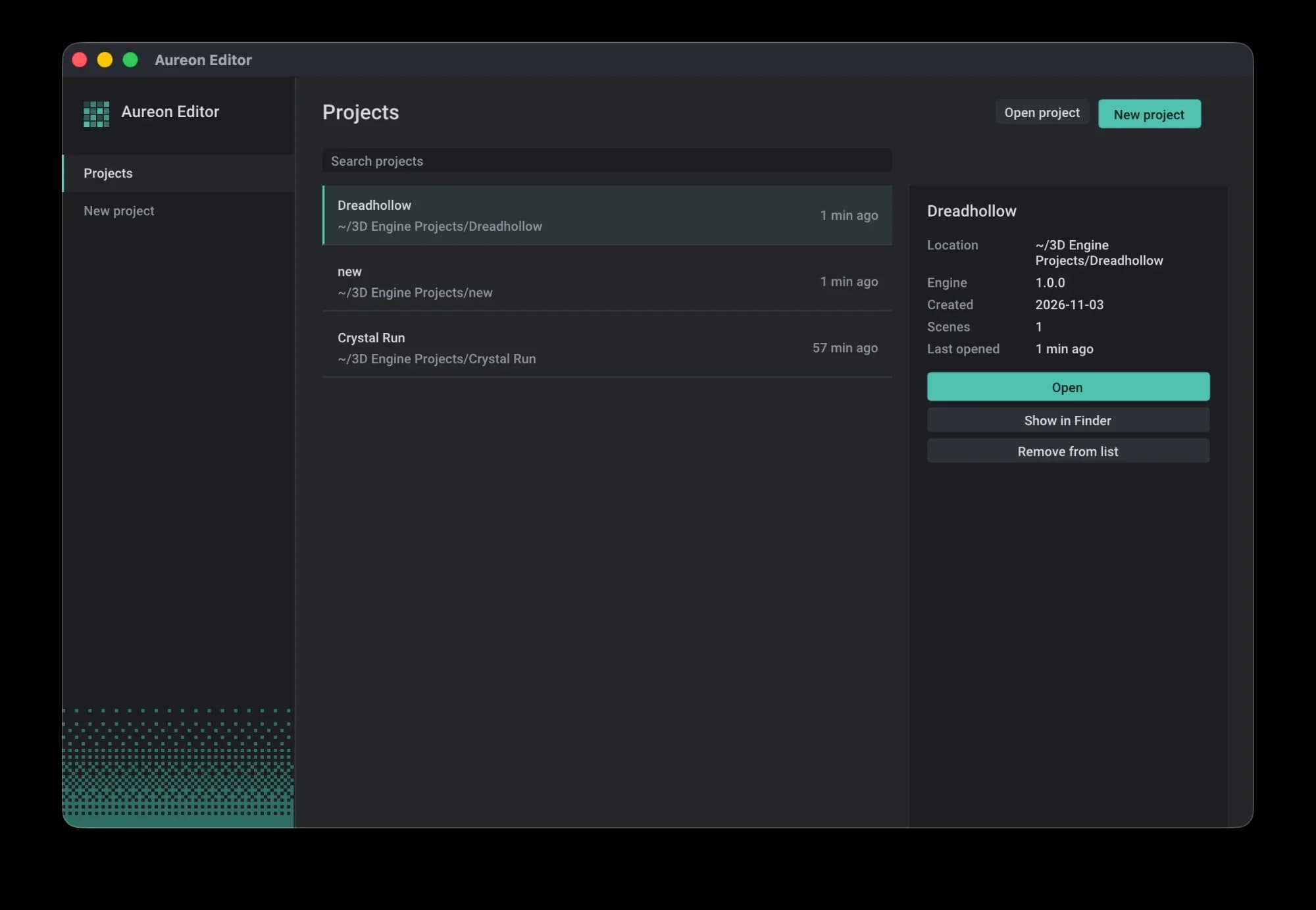
A real-time 3D engine and desktop editor in C++17 and OpenGL, with a project launcher, dockable panels, a play mode and tools for models, audio, terrain and code.
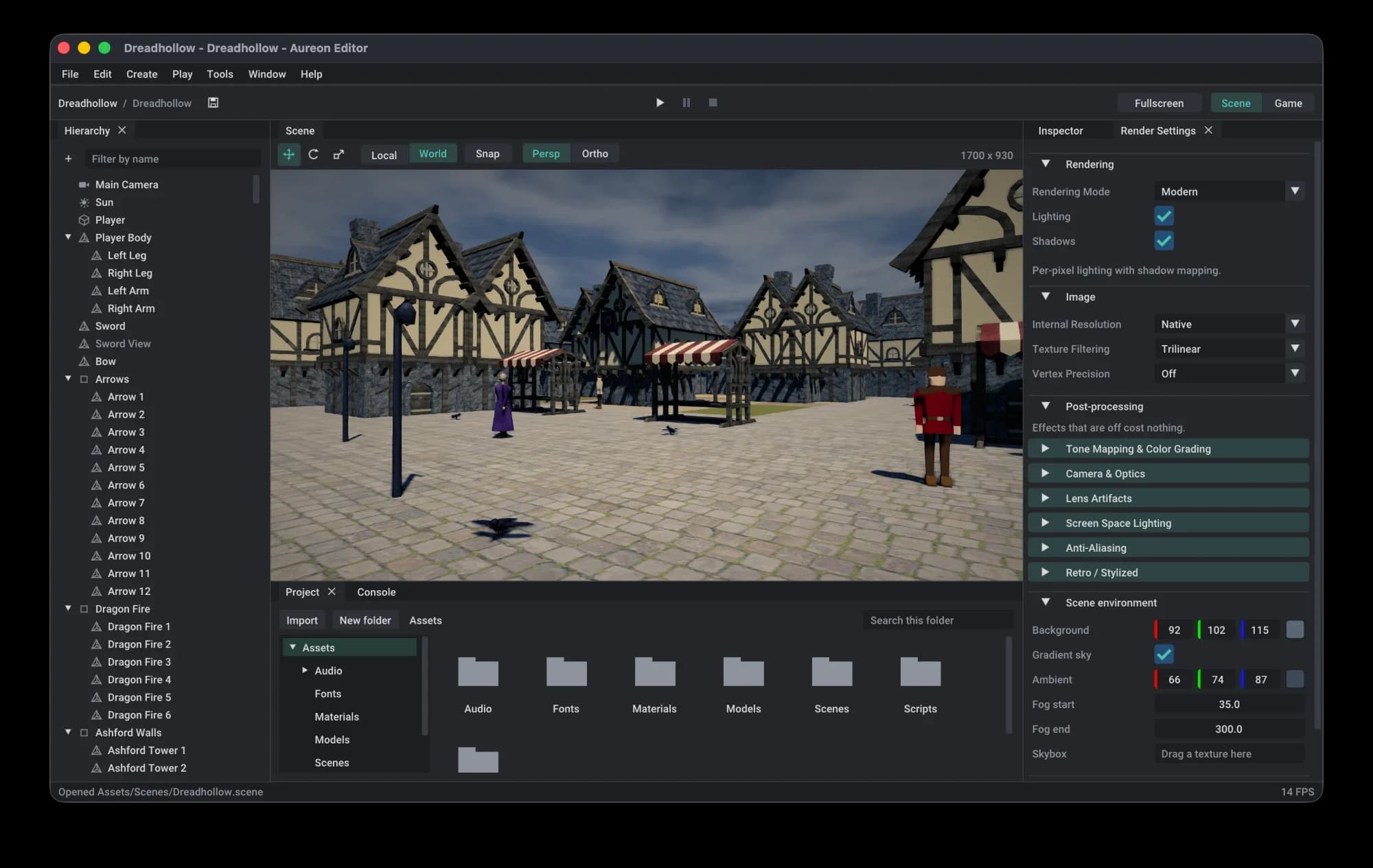
Aureon is a graphics project about real-time rendering, scenes, lighting, shadows and collision-based physics, with the PlayStation 1 and 2 as its visual direction.
It is split into three parts: the engine as a static library with no UI code, a desktop editor built on it, and a standalone demo with the original sample scenes.
Projects live wherever you choose, outside the engine. Scenes refer to assets by project-relative path, so a project can be moved or renamed on disk.
How it grew
- Nov 2025
Started as a student project to learn how a 3D engine works from the ground up.
- Dec 2025
Grew into a working renderer, with lighting, shadows, post-processing and simple physics.
- Jan 2026
Alexlp06 joined and the engine's foundations were reworked.
- Nov 2026
Became a full engine and editor, split into separate parts, with a project launcher and a play mode.
- Nov 2026
Gained scripting, sound and built-in tools for making a game without leaving the editor.
Retro rendering, switched per project
Modern mode shades per pixel. PS1 mode lights per vertex and maps textures affinely, PS2 mode lights per vertex with perspective-correct textures. Internal resolution, vertex snapping, colour quantization and 4×4 Bayer dithering complete the look, and a test checks that every render setting changes the rendered image.
Effects that cost nothing while off
Tone mapping, bloom, depth of field, SSAO, FXAA, lens effects and a CRT screen each have their own switch. A disabled effect runs no passes and allocates no buffers; the enabled ones ping-pong between two buffers in a fixed order.
Lighting for large worlds
Sun shadows follow the camera in steps of whole shadow-map texels, so their edges do not crawl. The eight fires, lanterns and windows nearest the camera light what is around them, per vertex in the retro modes as the PlayStation did. Frustum and fog-distance culling keep scenes with thousands of objects fast.
Games without code, or with C++ scripts
Any scene with a Player is playable. Objects take roles in the Inspector, from pickups and hazards to villagers, wolves and dragons. Scripts are C++ classes in the project; Play compiles them with clang++ and loads them, and Stop restores a snapshot so play never reaches the saved scene.
Tools inside the editor
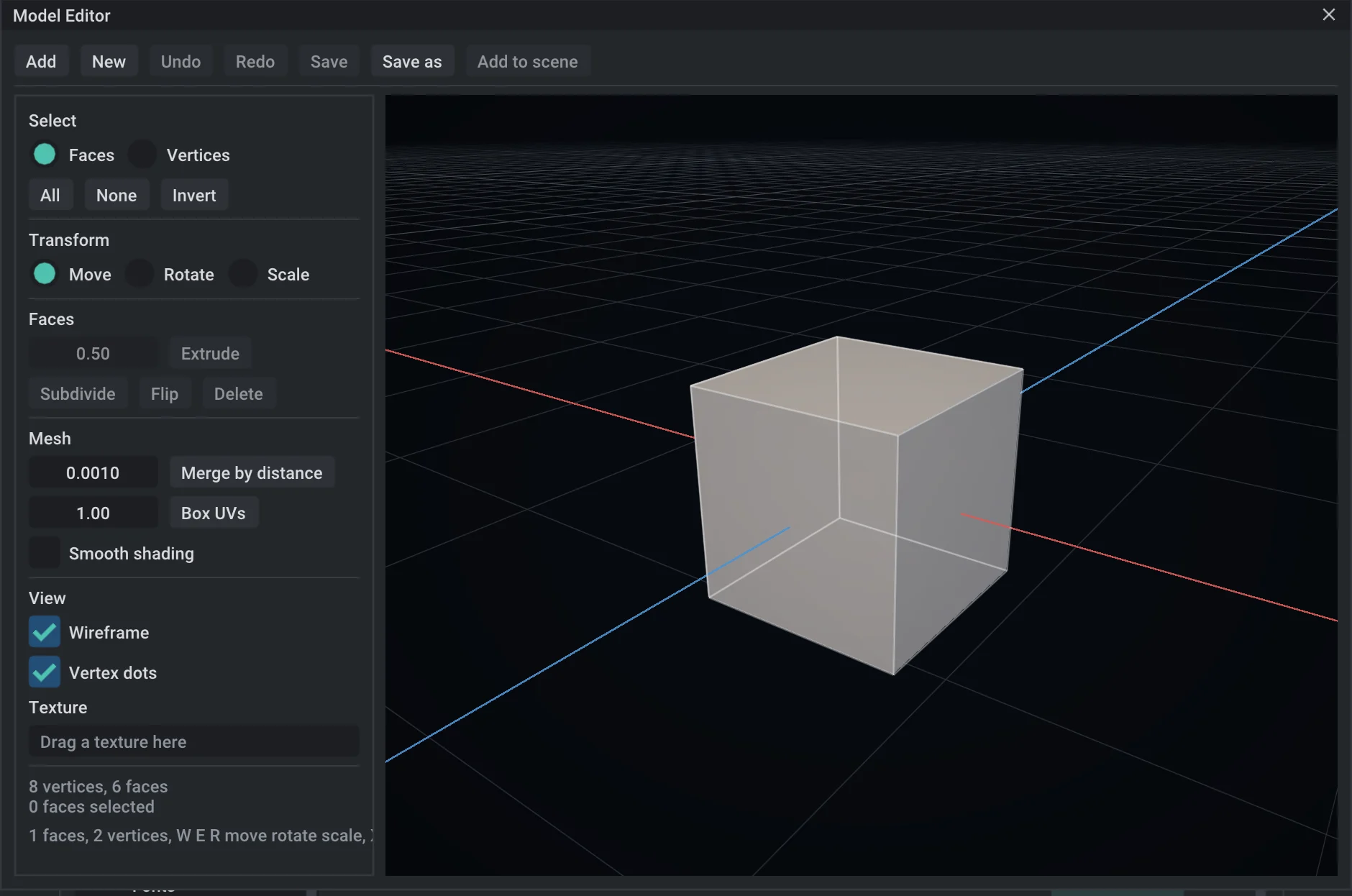
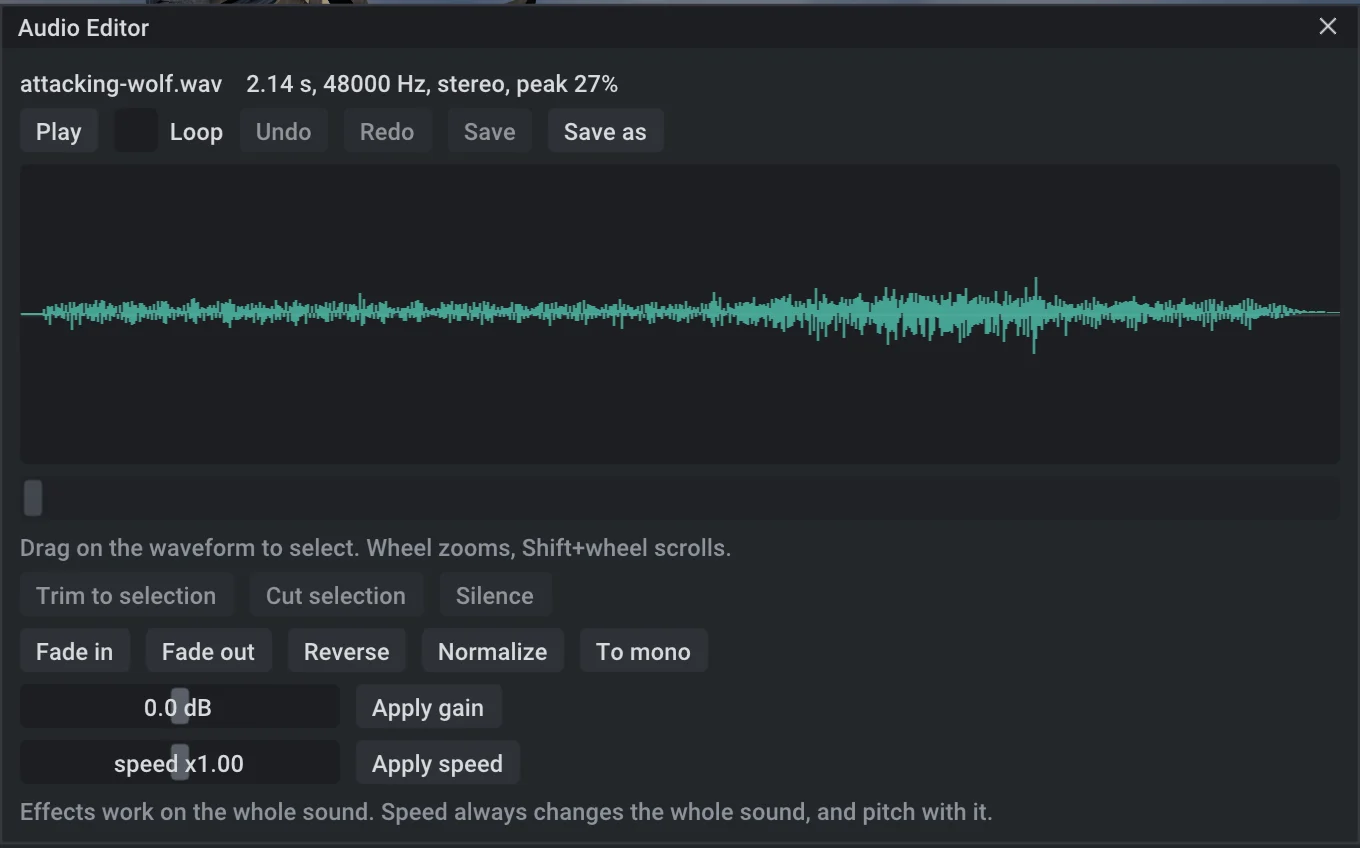
A code editor, an audio editor for WAV files, a terrain editor with sculpting and painting brushes, and a model editor that edits faces and vertices with the engine's own renderer and saves .obj files.